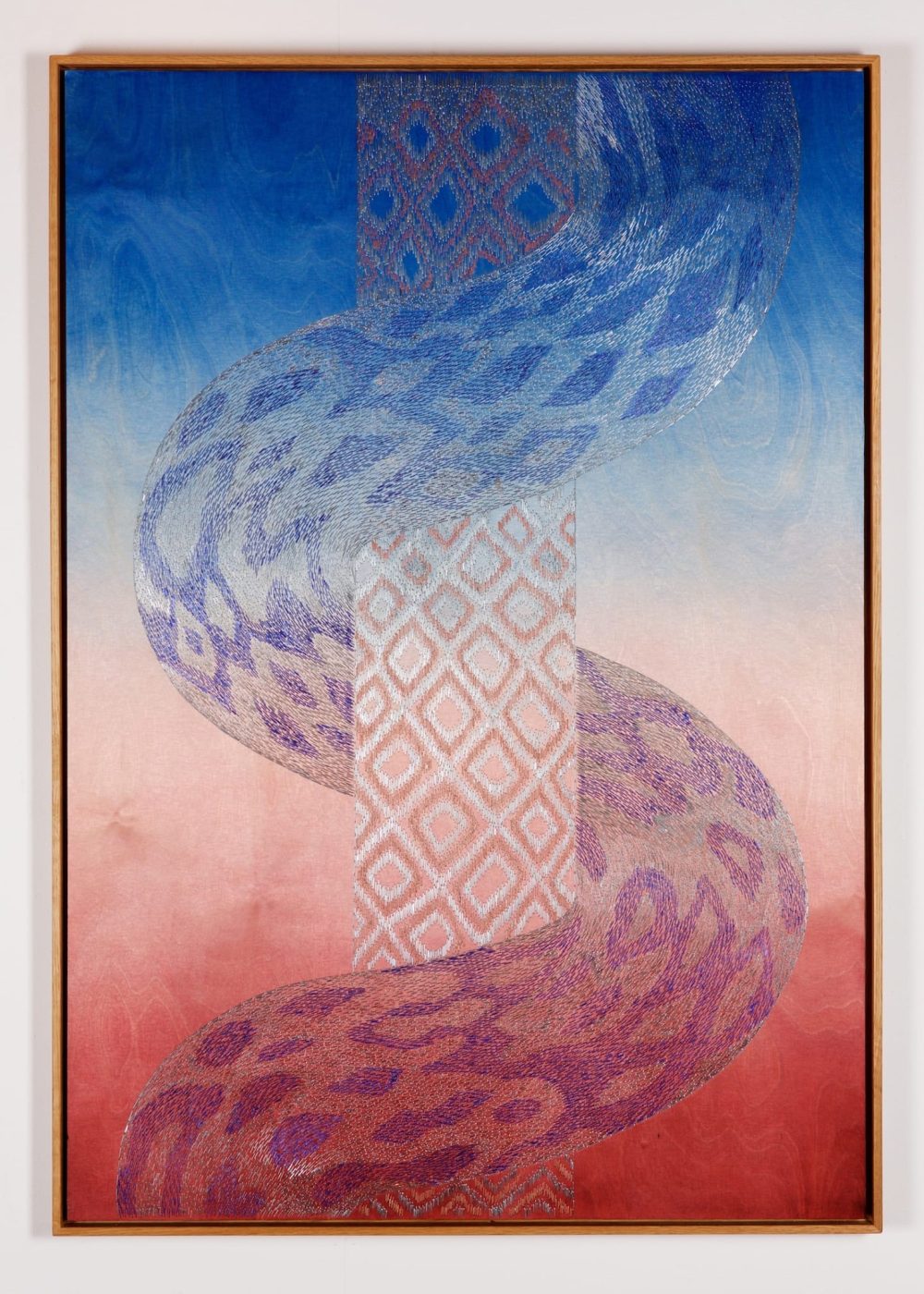
Mami Wata
2022
Metal staples on wood.
83 × 118 cm
10 kg
Mami Wata is part of the Remedy for Life series which takes the artist back to her roots.
It deals with Sasha Huber's relationship with belonging and the element of water, and with the importance of the Rhine river, in particular, since she grew up beside it. It reflects the way she finds a sense of being at home next to lakes and the sea after relocating to Finland over twenty years ago, and how the sea also connects her to the shores of her maternal home in faraway Haïti.
Remedy for Life further reflects on the urgency of caring for all waters, which are gradually diminishing and in places are polluted by the effects of colonialism and industrial exploitation.
For many years now, Huber has claimed the compressed-air staple gun as
€15,000
Sasha Huber (b. 1975) is a Swiss-Haitian artist based in Helsinki whose work explores the afterlives of colonialism and its ongoing influence. Working with photographs, video, performance, archives, place names, and historical records, she asks how violence is preserved in cultural memory and how art can intervene in this process.
One of her best-known tool is the staple gun, which she has used since 2004, when she began the series Shooting Back. Originally conceived as an act of return fire, the technique has become a way to symbolically close the wounds caused by colonialism. By replacing the brush with a staple gun, Huber shoots staples into wood and acoustic panels, turning a tool associated with violence into an instrument of care.
In portraits of people of the African diaspora, the acoustic panels serve as a support and a metaphorical amplifier, giving a voice back to those whom history has silenced. The works restore dignity and individuality to people who were dehumanized by slavery.
Her method begins with research and continues beyond the gallery. Huber turns to places named after Louis Agassiz, a glaciologist whose racial theories helped legitimize scientific racism. More than 80 places on Earth, the Moon, and Mars bear his name, and her reparative interventions are part of an international campaign to reassess his legacy. In Alaska, she traveled with Khaách Jeremiah James to the Agassiz Glacier, which lies on Indigenous territory, to collect glacial water for a future renaming ceremony in Yakutat, the ancestral home of James and his family. Together with the artist Petri Saarikko, she is also developing the long-term project Remedies Universe, which explores family knowledge and healing practices in different cultural contexts.
Her origins shape her work. She draws attention to the abduction and enslavement of some of her ancestors between Africa and Haiti, and to the racism and discrimination that still result from this violence. Through acts of repair, renaming, and remembrance, she puts her art in the service of decolonizing knowledge, making reparations for history, and a gradual process of healing.